

PERSON: Naomi Collier
Position
Activist
Biography
There’s an analogy Naomi Collier’s father likes to use to when describing the societal disadvantages black people face.
“If you start one man off in a race, and you keep chains on the other one’s feet for 400 years, how is the second man ever going to catch up?”
By putting all that energy into catching up, said Brian Collier, 54, of St. Louis, the chained man becomes exhausted.
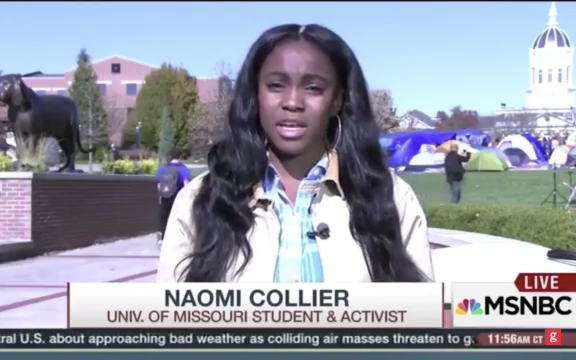
Exhausted was exactly how Naomi Collier, a sophomore sports management and black studies student at MU, felt on Tuesday morning. It was five hours after she had fallen asleep, nine hours since she and a group of 60 protesters left the Daniel Boone City Building and 10 hours since the St. Louis County prosecutor announced that a grand jury had chosen not to indict Darren Wilson, a white Ferguson police officer who shot and killed Michael Brown, an unarmed black teenager, in August.
“It takes a toll when you are optimistic about a result, and lo and behold, it doesn’t happen,” Naomi Collier said. “I felt anxious, infuriated, sad and hurt.”
Still, Collier remains determined to win the race.
Collier joined the MU4MikeBrown group for the grand jury announcement Monday night at MU’s Speakers Circle. After watching the live stream on their smart phones, the group marched downtown to join other protesters in front of the Daniel Boone City Building. She was one of the younger and most passionate protesters. A white woman in her late 30s gave a shivering Collier her gloves after she spoke.
Collier’s remarks touched on Eurocentrism, racial profiling and the Civil Rights movement. She also thanked the diverse crowd for coming out on such a cold night.
“I was very happy to see all the people out there who did not look like me,” Collier said. “There were probably a lot of black people out there who, at that moment, didn’t want to see white people out there ... because you’re looking at them as the opposite side, and they are the problem. And you have to be able to reason in that moment ‘No, they are not.’ The ones who decided to stay at home or the ones who don’t want to get involved with this issue — they are the problem.”
Collier describes herself as pro-black. She is an officer of the Legion of Black Collegians and MU’s chapter of the NAACP. She also is part of the United Ambassadors Minority Recruitment Team.
Collier, however, wasn’t raised among black people in her south St. Louis neighborhood. Middle-age whites surrounded her home on Christy Avenue. Brian Collier moved his family around the city repeatedly to avoid gang violence.
Naomi Collier attended a magnet high school where the racial diversity didn’t match that of other public high schools in the city. So when she arrived at MU, she immersed herself in as many black interest groups as possible.
While she has enjoyed her leadership roles with MU’s black student groups, she also has to be careful at protests like the one on Monday night. Mary Ratliff, the head of Missouri’s NAACP chapter, did not approve of the March. Collier made sure to disassociate herself from the group before her speech so she wouldn’t misrepresent it.
That’s why MU4MikeBrown has been a positive outlet for her. It’s more grass roots than others and tries to promote awareness about police brutality.
It’s a subject that hits close to home for Collier and her father. She recalled an incident in which Brian Collier was riding his bicycle down an alley in his neighborhood at night when an officer stopped him. The officer was responding to a 911 call and saw Collier, a black man in a white neighborhood. The officer threatened to “beat his head in” with a baton.
That event sticks with Naomi Collier and causes the Michael Brown episode to resonate even more. She also recalled during her remarks at city hall Monday night the sense of loss she felt when an acquaintance, Flynt Clemons, was shot and killed by another black man in a Domino’s Pizza store on the same day Brown was shot. It was a devastating time for her, she said.
Naomi Collier wants all officers to wear lapel cameras and to stop discriminating against blacks. She said she has experienced discrimination from police herself.
Last month, after getting her hair done by her favorite beautician, who happens to be in Ferguson, a police officer stopped her as she was driving back to Columbia. He questioned whether she was really enrolled at MU.
The aspiring sports agent said she won’t let people limit her because of the color of her skin.
“I have the potential for much, much more,” Naomi Collier said.
>> The Columbia Missourian
“If you start one man off in a race, and you keep chains on the other one’s feet for 400 years, how is the second man ever going to catch up?”
By putting all that energy into catching up, said Brian Collier, 54, of St. Louis, the chained man becomes exhausted.
Exhausted was exactly how Naomi Collier, a sophomore sports management and black studies student at MU, felt on Tuesday morning. It was five hours after she had fallen asleep, nine hours since she and a group of 60 protesters left the Daniel Boone City Building and 10 hours since the St. Louis County prosecutor announced that a grand jury had chosen not to indict Darren Wilson, a white Ferguson police officer who shot and killed Michael Brown, an unarmed black teenager, in August.
“It takes a toll when you are optimistic about a result, and lo and behold, it doesn’t happen,” Naomi Collier said. “I felt anxious, infuriated, sad and hurt.”
Still, Collier remains determined to win the race.
Collier joined the MU4MikeBrown group for the grand jury announcement Monday night at MU’s Speakers Circle. After watching the live stream on their smart phones, the group marched downtown to join other protesters in front of the Daniel Boone City Building. She was one of the younger and most passionate protesters. A white woman in her late 30s gave a shivering Collier her gloves after she spoke.
Collier’s remarks touched on Eurocentrism, racial profiling and the Civil Rights movement. She also thanked the diverse crowd for coming out on such a cold night.
“I was very happy to see all the people out there who did not look like me,” Collier said. “There were probably a lot of black people out there who, at that moment, didn’t want to see white people out there ... because you’re looking at them as the opposite side, and they are the problem. And you have to be able to reason in that moment ‘No, they are not.’ The ones who decided to stay at home or the ones who don’t want to get involved with this issue — they are the problem.”
Collier describes herself as pro-black. She is an officer of the Legion of Black Collegians and MU’s chapter of the NAACP. She also is part of the United Ambassadors Minority Recruitment Team.
Collier, however, wasn’t raised among black people in her south St. Louis neighborhood. Middle-age whites surrounded her home on Christy Avenue. Brian Collier moved his family around the city repeatedly to avoid gang violence.
Naomi Collier attended a magnet high school where the racial diversity didn’t match that of other public high schools in the city. So when she arrived at MU, she immersed herself in as many black interest groups as possible.
While she has enjoyed her leadership roles with MU’s black student groups, she also has to be careful at protests like the one on Monday night. Mary Ratliff, the head of Missouri’s NAACP chapter, did not approve of the March. Collier made sure to disassociate herself from the group before her speech so she wouldn’t misrepresent it.
That’s why MU4MikeBrown has been a positive outlet for her. It’s more grass roots than others and tries to promote awareness about police brutality.
It’s a subject that hits close to home for Collier and her father. She recalled an incident in which Brian Collier was riding his bicycle down an alley in his neighborhood at night when an officer stopped him. The officer was responding to a 911 call and saw Collier, a black man in a white neighborhood. The officer threatened to “beat his head in” with a baton.
That event sticks with Naomi Collier and causes the Michael Brown episode to resonate even more. She also recalled during her remarks at city hall Monday night the sense of loss she felt when an acquaintance, Flynt Clemons, was shot and killed by another black man in a Domino’s Pizza store on the same day Brown was shot. It was a devastating time for her, she said.
Naomi Collier wants all officers to wear lapel cameras and to stop discriminating against blacks. She said she has experienced discrimination from police herself.
Last month, after getting her hair done by her favorite beautician, who happens to be in Ferguson, a police officer stopped her as she was driving back to Columbia. He questioned whether she was really enrolled at MU.
The aspiring sports agent said she won’t let people limit her because of the color of her skin.
“I have the potential for much, much more,” Naomi Collier said.
>> The Columbia Missourian
ClipsBank
Full
Compact
NewsBase
Full
Compact
RadioBank
Full
Compact
PodBank
Full
Compact
TranscriptBank
Full
Compact
No data found


